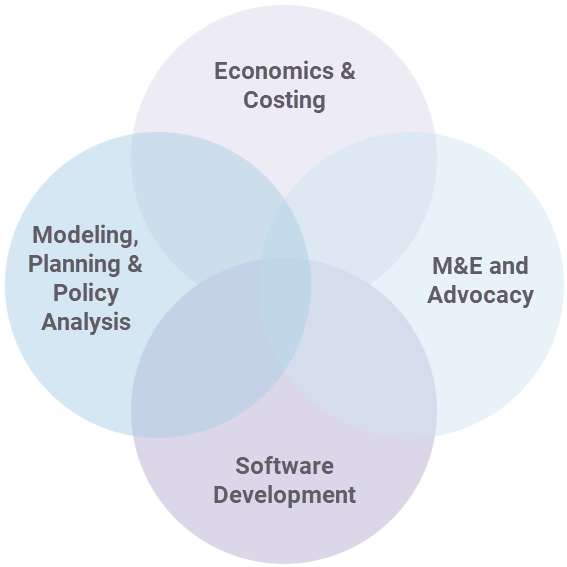
Our diverse team combines their wide range of expertise to unlock new and better ways to analyze, use, and manage data to advance global health.
Our staff collaborates across four integrated centers of excellence. Select a center tab below to see its description.
Center for Modeling, Planning & Policy Analysis
Our Modeling, Planning & Policy Analysis (MPPA) staff are pioneers in the field of demographic and disease projection modeling and have produced many of the models trusted and used by HIV/AIDS, TB, reproductive, maternal and child health, and NCD program and policy experts around the world. These tools support countries to understand disease burden, and potential courses of action and associated resource requirements, to improve the health of their populations. By modeling cost, demographic and health outcome changes associated with policies under consideration, and translating the results into data and graphics that support strategic planning, our models help stakeholders prioritize and make decisions about how to best use limited resources to advance health goals.
While the modeling and analytics are complex, we specialize in user-friendly interfaces, making the models accessible for a variety of audiences. Our models are well documented, with manuals, training materials, and default databases available online for easy reference. We put special emphasis on capacity building through frequent regional and country training workshops, technical assistance and support for modeling positions within national organizations.
The MPPA team takes a uniquely collaborative approach to model development and routinely works with expert groups such as the UNAIDS Reference Group on Estimates, Models and Projections, the UN Interagency Working Group on Costing, the Tuberculosis Modeling Consortium, and others, sharing knowledge to advance the field. The model development process includes country applications to field-test the models and generate feedback from intended users. This process results in models that are informed by a variety of experts and establishes a rigorous vetting process.
Key areas of expertise
- Development of models for evidence-based advocacy, policy and planning
- Projection models such as AIM and the STI model estimate the burden of diseases such as HIV, non-communicable diseases, and other conditions.
- Advocacy models, such as RAPID and AIDS Impact Model (AIM), use an array of scientific and programmatic data to help policy makers understand the consequences of current health trends and potential solutions.
- Planning models, such as the Integrated Health Tool/OneHealth Tool, Goals and the Resource Needs Model, use available data to estimate the resources and effort required to achieve national goals.
- Model applications including multi-country scenario analysis for donor and multi-lateral decison making, country support for national strategic plan development and costing, and investment case development for prioritization.
- Facilitation of dialogue and learning around data for decision making. Avenir Health works as a conduit to create opportunities for all stakeholders, (e.g., researchers, analysts, policy makers and community and grass roots leaders) to come together to discuss what the data show, and how they affect key policy questions.
Partnerships for Impact
The Center for Modeling, Planning & Policy Analysis collaborates with a diverse range of partners, including:
- Country Governments: Departments of planning, FP, RMNCAH, HIV, TB, and NCDs, among others.
- Multilateral Organizations: UNFPA, UNAIDS, WHO, CDC, UNICEF.
- Donors: USAID, CIFF, Gates Foundation, Global Fund, GFF.
- Regional and Global Initiatives: Reproductive Health Supplies Coalition, Stop TB Partnership.
- Corporations: GSK, Merck, Johnson & Johnson.
Signature Models
The Center for Modeling, Planning & Policy Analysis collaborates with a diverse range of partners, including:
- Spectrum suite of tools, including demographic projections (Demproj), HIV models (AIM, Goals, Resource Needs model), TB modeling, NCD modeling tools, maternal and child survival mode (Lives Saved Tool).
- Health system planning tools, including the desktop-based OneHealth Tool and web-based Integrated Health Tool for planning and costing.
- Detailed operational planning tools including Prep-It, and DMPPT.
- And more web-based and desktop tools.
Center Contacts
Center Director: Rachel Sanders
Center Deputy Director: Dr. Robert Glaubius
Center for Economics & Costing
The Center for Economics & Costing is a leader in generating, analyzing, and using cost and financing data to inform health policy and planning, and performing economic evaluations. We have implemented primary costing activities across a wide range of health services, including PrEP, VMMC, ART, family planning, TB, and social and behavior change (SBC) interventions.
The cost and financing data generated by the center is used by stakeholders to inform decision making and increase program efficiency and impact. The team applies both traditional costing approaches and an activity-based costing and management (ABC/M) approach to generate primary cost data on the delivery of health services to better understand cost drivers and improve the efficient allocation of resources. The center's contribution to costing aspects of tools such as the OneHealth and IntegratedHealth Tools assist program planners in understanding and budgeting for the inputs needed to achieve program goals. In addition, the team supports harmonization, verification, and tracking of budget and expenditure data across funding sources, and synthesizes and analyzes related program and macroeconomic data, to inform program and sustainability planning at the country level.
Our holistic approach comprises synthesizing the existing evidence, generating new evidence to fill identified costing and cost-effectiveness evidence gaps, and fostering increased data use by developing resources and tools to support both the collection and use of cost data.
Key areas of expertise
- Economic evaluations, including cost-effectiveness analyses and benefit-cost analyses.
- Costing of national and decentralized health programs.
- Primary Data collection to fill data gaps, including Activity-based Costing and Management.
- Analysis of markets and approximation of potential markets.
- Literature syntheses and data analyses.
- Estimation of complex indicators.
- Capacity-building activities and resources to increase technical knowledge and strengthen use of data for efficiency and accountability, including program planning and budgeting.
- Investment case studies.
- Creation of online repositories for cost information.
Partnerships for Impact
The Center for Economics & Costing collaborates with a diverse range of partners, including:
- Multilateral Organizations: Global Fund, UNAIDS, WHO, UN Interagency Working Group.
- Donors: USAID, PEPFAR.
- Country Governments: Ministries of Health, Finance, Planning, etc. focusing on health areas of FP, RMNCAH, HIV, TB, and NCDs, among others.
- Regional & Global Initiatives: Global Health Cost Consortium, Resource Alignment for HIV Collaboration, Interagency Working Group on Costing.
Signature Tools
- Online repositories for cost information: Unit Cost Study Repository, FP Unit Cost Database
- Online dashboard displaying resource alignment data for sustainability planning
- Other tools and analyses developed include:
- Tool to help design differentiated care model programs for ART.
- Tool to display aligned resources across PEPFAR, Global Fund, Domestic governments, and other funders in HIV.
- The costing module in PrEP-it, a tool for PrEP implementation planning, monitoring and evaluation.
- Tool for sustainability planning to evaluate the trade-offs between changing costs, funders, and epidemiological patterns.
- Business cases for social and behavior change for family planning, malaria, and maternal and child health.
- Analyses using cost, expenditure and beneficiary data for key population and general population outreach programs.
Center Contact
Center Director: Dr. Lori Bollinger
Center for Monitoring & Evaluation and Advocacy
The Center's experts include data analysts, demographers, economists and predictive modelers who work together to improve and advance health monitoring, evaluation and advocacy at the country, regional, and global levels. This range of expertise allows the team to integrate data analysis, interpretation and visualizations with deep country relationships and technical knowledge to provide a broader view to guide strategic decisions.
The team has developed innovative models, tools, and approaches that leverage survey data, service statistics, and modelled estimates in unique ways that provide enhanced insights to guide evidence-based decision-making. These innovations have standardized and advanced the reproductive health monitoring and evaluation (M&E) field and been adopted by country governments, global and regional initiatives, donors, multilaterals, and partners.
A central tenant of the Center's work with countries is sustainability. The team leverages and builds on existing government systems rather than building parallel external ones. They look to build internal government capacity and systems to reduce reliance on external partners and increase data autonomy. Avenir Health's advanced analytic tools and data system enhancements facilitate programs' ability to use their own routine data to efficiently identify opportunities and remove barriers to progress, placing governments as the leaders in driving meaningful change.
Key areas of expertise
- Building Capacity to Use Women's Health Data: Improving internal government capacity to understand and use data for monitoring, decision making, and governance.
- Data Analysis and Visualization: Developing interactive tools and predictive models to extract valuable insights from complex datasets and visualize results.
- Strategic Planning: Supporting the development of evidence-based strategic plans, monitoring frameworks, resource allocation decisions, and evaluations.
- Innovations in HMIS: Developing a DHIS2 app to increase whole health system access to analytics, data quality review, and data visualizations, and building interoperable data warehouses to ensure that FP/MCH is included in countries' expanded data ecosystems.
- Advanced Data Analytics: Employing advanced statistical techniques to uncover hidden patterns and trends.
- Indicator Development: Leverage existing data sources to create new indicators that more accurately measure progress on women's health issues.
- Prime data collection on health expenditures and costing: Increasing the data available on domestic expenditures and costing to inform budgeting, planning, and advocacy.
Partnerships for Impact
The Center for MEA collaborates with a diverse range of partners, including:
- Country Governments in over 35 countries (FP, MNCH, HIV, HMIS, BoS, departments..)
- Regional & Global Initiatives (FP2020/2030, Ouagadougou Partnership, Countdown to 2030)
- Multilateral (UNFPA, GFF, UNAIDS, WHO, CDC)
- Donors (USAID, FCDO, CIFF, Gates Foundation)
Signature Tools
The MEA team has developed a suite of powerful tools to support data-driven decision-making in women's health, including:
- Tools for production of annual Family Planning indicators, including the Family Planning Estimation Tool (FPET), Service Statistics to Estimated Modern Use (SS to EMU) tool, and Track20 Annual Estimate Calculator.
- Tools for strategic planning and evidence-based decision-making, including FP Goals, Maximum CPR Tool, Potential Market of Self-Injectable Contraceptive Users Model, and many others.
- Tools that support enhanced analyses and visualization of HMIS data (FP, maternal & child health) within government systems like the DataPro DHIS2 App.
Center Contacts
Center Director: Dr. Emily Sonneveldt
Center Deputy Director: Priya Emmart
Center for Software Development
The Center for Software Development directly supports Avenir Health's other technical centers by providing essential IT skills. These include web and desktop application development, data analysis, and website presentation. As developers, the team plays a unique role in the global health sphere by providing tools that are user-friendly, freely available, up-to-date, and methodologically sound.
Avenir Health's tools are utilized by global health professionals, regional consulting teams, and host country government officials and consultants. The center strives to produce user-friendly tools that have long-term utility for the global health community and can be used independently without input from Avenir Health. Our uniqueness lies in working directly with global health professionals internally and externally during the development and support processes.
Key areas of expertise
- User Interface/User Experience: The applications we develop combine functionality with an aesthetically pleasing look and feel. This ensures that users can easily and effectively interact with our applications while feeling confident and satisfied throughout their journey. Every design decision prioritizes the user's needs, offering clarity, accessibility, and efficiency, while maintaining a positive experience.
- Cloud Computing: Managing and deploying scalable, secure, and efficient cloud-based solutions using platforms like Azure. This includes skills in cloud architecture, virtualization, and automation tools to optimize resources, cost and Internet connectivity.
- Data Visualizations: Proficiency in data visualizations includes creating clear and insightful graphical representations of data using various tools. Data analysis, storytelling, and design principles are applied to convey complex information effectively.
- Application Programming Interface (API): Expertise in APIs to facilitate designing, building, and maintaining robust endpoints that enable seamless interoperability between software applications.
- Database Design: Proficiency in database design to ensure data integrity, efficiency, and scalability specifically when running data intensive models.
- Support Site: Interacting with application users via web-based ticketing systems. Users are able to interact directly with the programming team or appropriate modeler.
- Development languages: JavaScript (React, Vue), Python, C++, Node.js, R, and Delphi.
Center Contact
Center Director: Robert McKinnon